Description
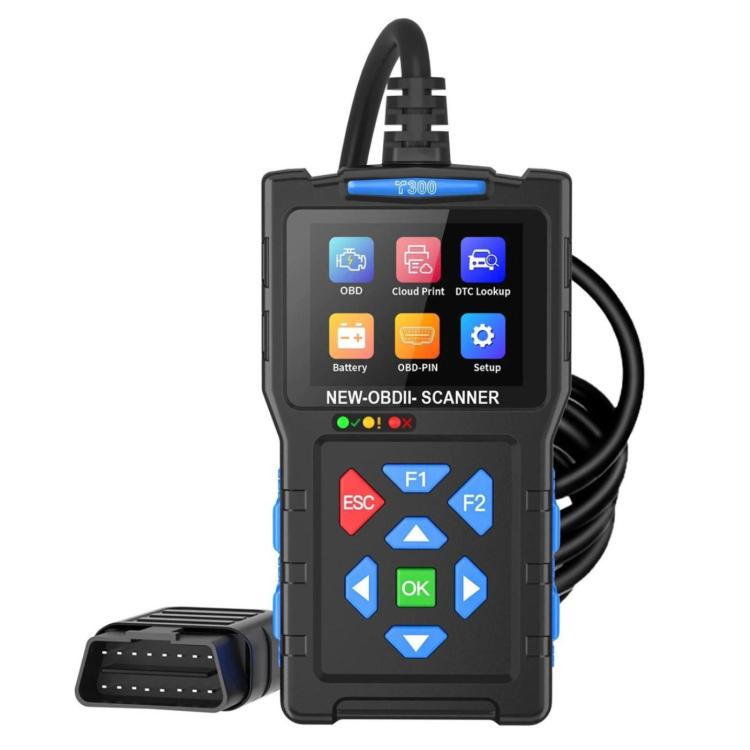
1. Display: 2.8-inch TFT color screen
2. External power supply: 8V-30V DC
3. No built-in lithium battery; requires power via the car’s OBD interface or an external power source (8-30V DC)
4. Intelligent matching, automatic scanning and connection; no need to manually select brand and model, making it more convenient to use.
5. Built-in more than 50,000 fault codes; quick lookup of fault code definitions.
6. Engine fault diagnosis; quickly reads car faults and clears the engine fault light.
7. View real-time vehicle data; vehicle status data is clear at a glance, ensuring your safe travels.
8. I/M status function is used to check the operation of the emission system on vehicles compliant with OBD-I1.
9. I/M shortcut key can be set for one-click access to view.
10. When the vehicle cannot be diagnosed, the OBD voltage function can be used to check the voltage of each pin of the OBD to help us find the vehicle fault more quickly.
11. Upgrade programs can be downloaded via PC and upgraded by connecting devices through a Type-C circuit.
12. Supports multiple languages: English, Spanish, French, Italian, Russian, Portuguese, German, Polish, Dutch, Japanese, Turkish, Indonesian, and Chinese
13. 93CM extended cable, longer cable for easier use
14. Supports up to 9 different protocols, supporting multiple vehicle brands:
– SAE J1850 PWM (41.6Kbaud)
– SAE J1850 VPW (10.4Kbaud)
– ISO9141-2 (5 baud init, 10.4 Kbaud)
– ISO15765-4 CAN (11bit ID, 500 Kbaud)
– ISO15765-4 CAN (29bit ID, 500 Kbaud)
– ISO15765-4 CAN (11bit ID, 250 Kbaud)
– ISO15765-4 CAN (29bit ID, 250 Kbaud) Kbaud)
– ISO14230-4 KWP (fast init, 10.4 Kbaud)
– ISO14230-4 KWP (5 baud init, 10.4 Kbaud)


 English
 Arabic